 Cam Music
Cambridge music venues at a glance
For a city of its size, Cambridge has an unusually layered set of music venues. A Victorian grain hall takes the big touring shows, a purpose-built university hall carries the classical season, an arts centre by the railway handles indie bands and club nights, and dozens of college chapels supply free choral music most evenings in term. Around them sit a theatre founded by an economist, a gallery that has hosted chamber music for half a century and, just outside the city, two newer halls that have quickly earned a following. This guide runs through the main rooms, what each is best for and how big it is.
The capacities below come from the venues and from published venue data. Several rooms change their layout show by show, so a figure is a ceiling rather than a promise, and the venue's own booking page is the place to check seating plans and access before buying.
| Venue | Best for | Capacity | Where |
|---|---|---|---|
| Cambridge Corn Exchange | Touring orchestras, rock and pop, comedy | up to about 1,850 | Wheeler Street, city centre |
| The Junction (J1) | Indie bands, club nights, comedy | about 850 standing | Clifton Way, by the station |
| Saffron Hall | Orchestras and chamber music | 740 seats | Saffron Walden, Essex |
| Cambridge Arts Theatre | Opera, musicals, touring productions | 664 seats | Peas Hill, city centre |
| West Road Concert Hall | Classical concerts, the university's orchestras | 499 seats | West Road, west of the river |
| Storey's Field Centre | Chamber, folk and small-scale concerts | about 180 seated | Eddington, north-west Cambridge |
Cambridge Corn Exchange
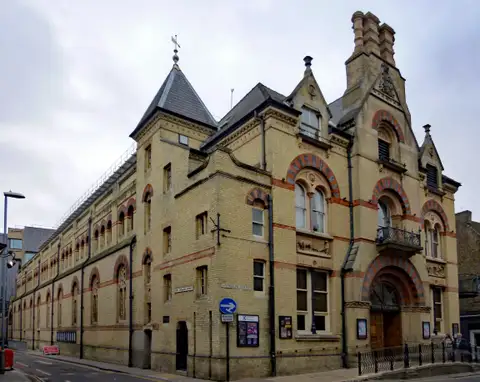
The Corn Exchange opened on Wheeler Street in 1875, designed by Richard Reynolds Rowe in the Gothic Revival style as a hall for the grain trade. Its brick exterior and iron roof survive, and the inside has been a concert venue for decades. Depending on the show, it holds up to about 1,850 people across a flat floor, tiered seating, a mezzanine and a balcony. That flexibility explains the programme: a symphony orchestra one night, a seated comedy tour the next, and a standing rock show at the weekend. It sits between the market square and the Arts Theatre, so the city's two largest centre-of-town stages are a minute's walk apart. The Cambridge Corn Exchange box office sells tickets through the Corn Exchange website, which also carries each show's prices, seating plan and access details; buying there rather than from a resale site is the surest way to pay face value.
West Road Concert Hall
West Road is the University of Cambridge's concert hall, part of the Faculty of Music site west of the river. It seats up to 499 in a raked, theatre-style auditorium and is the home stage for the Cambridge University Musical Society's orchestras and chorus; its programme is published on the West Road Concert Hall website. The Academy of Ancient Music, ensemble in residence at the faculty since 2004, gives concerts there each season, and visiting chamber groups and soloists fill many of the other dates. For classical music in Cambridge it is the first programme to check, and many student concerts there are priced well below what a comparable professional concert would cost.
The Junction
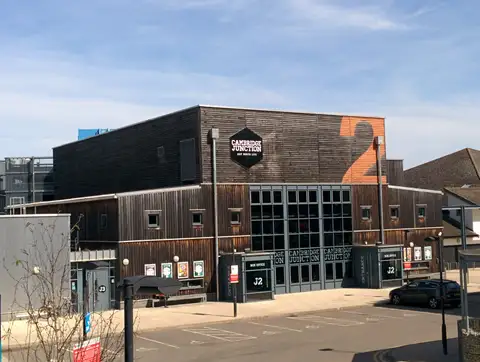
The Junction opened in 1990 on the site of the old cattle market just south of the railway station, built as an arts and entertainment centre for young people. The main hall, J1, holds around 850 standing according to the city council's descriptions, and two smaller spaces, J2 and J3, were added in the mid-2000s for theatre, dance and smaller gigs. It is the natural stop for touring indie and alternative bands, and many acts who later fill much larger halls played early shows there. Being less than ten minutes on foot from the station makes it the easiest venue in the city for a gig without a hotel. Listings and access information are on the Junction's website.
Cambridge Arts Theatre
The Arts Theatre on Peas Hill was founded in 1936 by the economist John Maynard Keynes, who wanted the city to have a stage for the best of the performing arts. It is a theatre first, but its programme regularly includes touring opera companies, musicals and the annual pantomime. A refurbishment funded by the Gatsby Foundation has renewed the auditorium, which now has 664 seats, so the old joke about its 666 seats no longer quite works.
Chapels, galleries and small rooms
Some of the best listening in Cambridge happens in rooms that were never built as venues. The college chapels host organ recitals and visiting choirs as well as their own services. Kettle's Yard, the house and gallery on Castle Street, has held concerts since 1970 and runs a chamber music series on Thursdays in term, played among the collection. Great St Mary's, the university church, offers free lunchtime concerts on Fridays outside the late summer. And the city's pubs and bars keep a steady calendar of folk sessions, jazz nights and open-mic evenings; the venues' own social channels are usually the most current listings for those.
Choosing a venue for the evening
The choice usually makes itself once the kind of music is clear. For an orchestra or a choral work, West Road and Saffron Hall offer the best sound, with the Corn Exchange taking the largest touring orchestras. For a band, the Junction suits anything up to its standing capacity, and the Corn Exchange takes the acts who have outgrown it. For something quieter, Kettle's Yard, Storey's Field and the chapels give a closeness that the big halls cannot. Seating matters as well: the Corn Exchange's balcony and the raked rows at West Road give clear sightlines, while a standing show at the Junction rewards arriving early for a place near the front. Each venue publishes its own access information, and it is worth reading before booking rather than on the night.
Beyond the city: Saffron Hall and Storey's Field
Two newer halls are worth knowing. Saffron Hall, a 740-seat concert hall built in the grounds of Saffron Walden County High School and opened in 2013, has become one of the best-regarded classical venues in the east of England, with resident orchestras and a strong chamber series; its programme and travel advice are on the Saffron Hall website. Audley End station is about two miles from the hall. Storey's Field Centre, opened in 2018 at the heart of the new Eddington district in north-west Cambridge, pairs a community centre with a main hall designed with specialist acoustic consultants; it seats about 180, or about 270 standing, and suits chamber, folk and jazz.