 Cam Music
Folk festivals UK: the shape of the season
Folk festivals in the UK run on a different clock from the big rock fields. Of the UK folk festivals people travel to, the best known sit within a few weeks of each other. Most of them are older, many are run by charities, councils or the bands themselves, and they cluster tightly between late July and the August bank holiday. Within those five or six weeks you can hear a ceilidh band in a Devon marquee, a sea-shanty session in a Kent pub and a folk-rock headliner in an Oxfordshire field, often on consecutive weekends.
The other difference is the shape of the event. Some folk festivals are classic greenfield weekends with a main stage and a campsite. Others are folk weeks that take over a whole seaside town, with hundreds of small concerts, workshops and dance displays spread across halls, churches and pubs. Knowing which kind you want is the most useful decision you can make before buying a ticket.
This guide starts with the festival on Cambridge's own doorstep and then works through the best-known UK folk festivals in the order they usually fall.
Cambridge Folk Festival
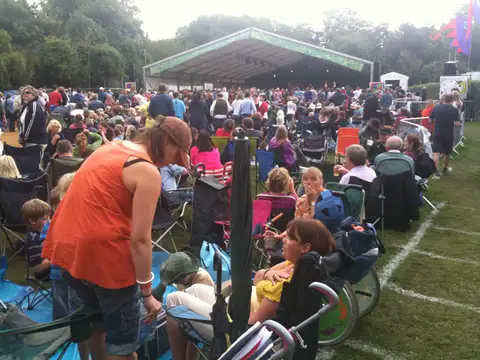
Cambridge Folk Festival is held in the grounds of Cherry Hinton Hall, a nineteenth-century house and park on the south-east side of the city, roughly two miles from Cambridge railway station. It has been running since 1965, which makes it one of the longest-established folk festivals in the world. The idea came from Cambridge City Council, and the man asked to make it happen was Ken Woollard, a local firefighter, who stayed on as its organiser and artistic director until his death in 1993.
The first festival sold about 1,400 tickets and almost broke even. Paul Simon was a late addition to that first bill, who had just released "I Am a Rock". Over the following decades the festival's reputation rested on a mix that few others attempted: traditional English and Scottish music alongside blues, bluegrass, Americana and singer-songwriters, all in one park. Emmylou Harris, Joan Baez, Van Morrison and Billy Bragg are among the names who have played there.
Its recent history has been less settled. The council ran the festival until 2015, a charity called Cambridge Live took it on for a few years, and the council resumed control in 2019. After a loss of around £320,000 on the 2024 edition, the 2025 festival did not go ahead. It came back in a new shape: a programme of concerts across Cambridge venues through July, including the Corn Exchange, Cambridge Junction and Storey's Field Centre, leading into the festival weekend at Cherry Hinton Hall around the end of July and the start of August.
Cambridge Folk Festival tickets and camping: a short guide
Cambridge Folk Festival tickets are released in phases, and full-weekend tickets usually go first. Full-festival tickets and single-day tickets are sold separately, and the first tier for the following summer has gone on sale in early October. In recent editions the first release sold out before the second opened, so anyone set on going should sign up for the festival's newsletter rather than wait for the line-up.
Camping and caravan pitches are sold as separate tickets on top of a festival ticket, and the caravan allocation has sold out early. The campsite surrounds the main arena inside the grounds, with the hall's duck pond and gardens within it, and it is not open to the public. Parking is at Netherhall School nearby and must be booked in advance. Without a car, the choice is a local bus or a bike from the station; the park entrance is on Cherry Hinton Road, and Cambridge is flat enough that cycling is the local default. The festival's own visitor FAQs carry the current details.
Fairport's Cropredy Convention
Every August the folk-rock band Fairport Convention hosts its own festival in a field outside the village of Cropredy, near Banbury in Oxfordshire. Fairport's Cropredy Convention usually runs from a Thursday to a Saturday in mid August, with Fairport opening the first night and closing the last, and it traditionally welcomes between 15,000 and 20,000 people. The crowd is loyal and the atmosphere is unhurried: one stage, a sloping field and the Oxford Canal running past the village.
Camping is on site, but campers need a concert ticket for the day they arrive. Capacity was reduced recently, which has made tickets harder to come by than they once were.
Seaside folk weeks: Sidmouth, Broadstairs and Whitby
The three great English seaside folk weeks are the opposite of a field festival, and for many listeners they are the best UK folk festivals of all. Instead of one site, the whole town becomes the venue.
Sidmouth Folk Festival in Devon has passed its seventieth edition and runs for eight days around the turn of July into August, with concerts, ceilidhs and dance displays along the esplanade. Broadstairs Folk Week in Kent follows in early to mid August, with more than 400 events in over 20 venues, around 160 of them free, and a big parade through the town on the first Saturday. Whitby Folk Week in North Yorkshire closes the run in the second half of August, with close to 600 events across more than 50 venues.
For newcomers, a folk week is the gentlest way in. You can buy a season ticket, a day ticket or just a ticket for one concert, and the free sessions in pubs and on the seafront cost nothing at all.
Shrewsbury and the August bank holiday
Shrewsbury Folk Festival takes the August bank holiday weekend at the West Midlands Showground on the edge of the town. It has four open-air and covered music stages, a dance tent, workshops and dedicated programmes for children and teenagers, and it is a good choice for families who want folk music without a week away.
The same weekend used to belong to Towersey, which billed itself as the UK's longest-running independent festival. Its organisers closed it after the sixtieth edition in 2024, citing the financial pressures that have hit many small festivals since the pandemic. Its absence is a reminder that no folk festival is guaranteed to come back, and that buying early helps keep the smaller ones alive.
The best UK folk festivals compared
Across the UK, the best choice depends on format as much as line-up. The table sets out the festivals in this guide by the time of year they usually take, with the format that defines each one. The figure below it lays the same events along the summer.
| Festival | Where | Usually | Format |
|---|---|---|---|
| Cambridge Folk Festival | Cherry Hinton Hall, Cambridge | City events in July, park weekend around 1 August | Park weekend with on-site camping |
| Sidmouth Folk Festival | Sidmouth, Devon | Eight days around late July and early August | Seaside folk week |
| Broadstairs Folk Week | Broadstairs, Kent | A week in early to mid August | Seaside folk week, 400+ events |
| Fairport's Cropredy Convention | Cropredy, Oxfordshire | Thursday to Saturday, mid August | Single-stage field, 15,000 to 20,000 |
| Whitby Folk Week | Whitby, North Yorkshire | A week in the second half of August | Seaside folk week, around 600 events |
| Shrewsbury Folk Festival | West Midlands Showground | August bank holiday weekend | Showground, four stages |